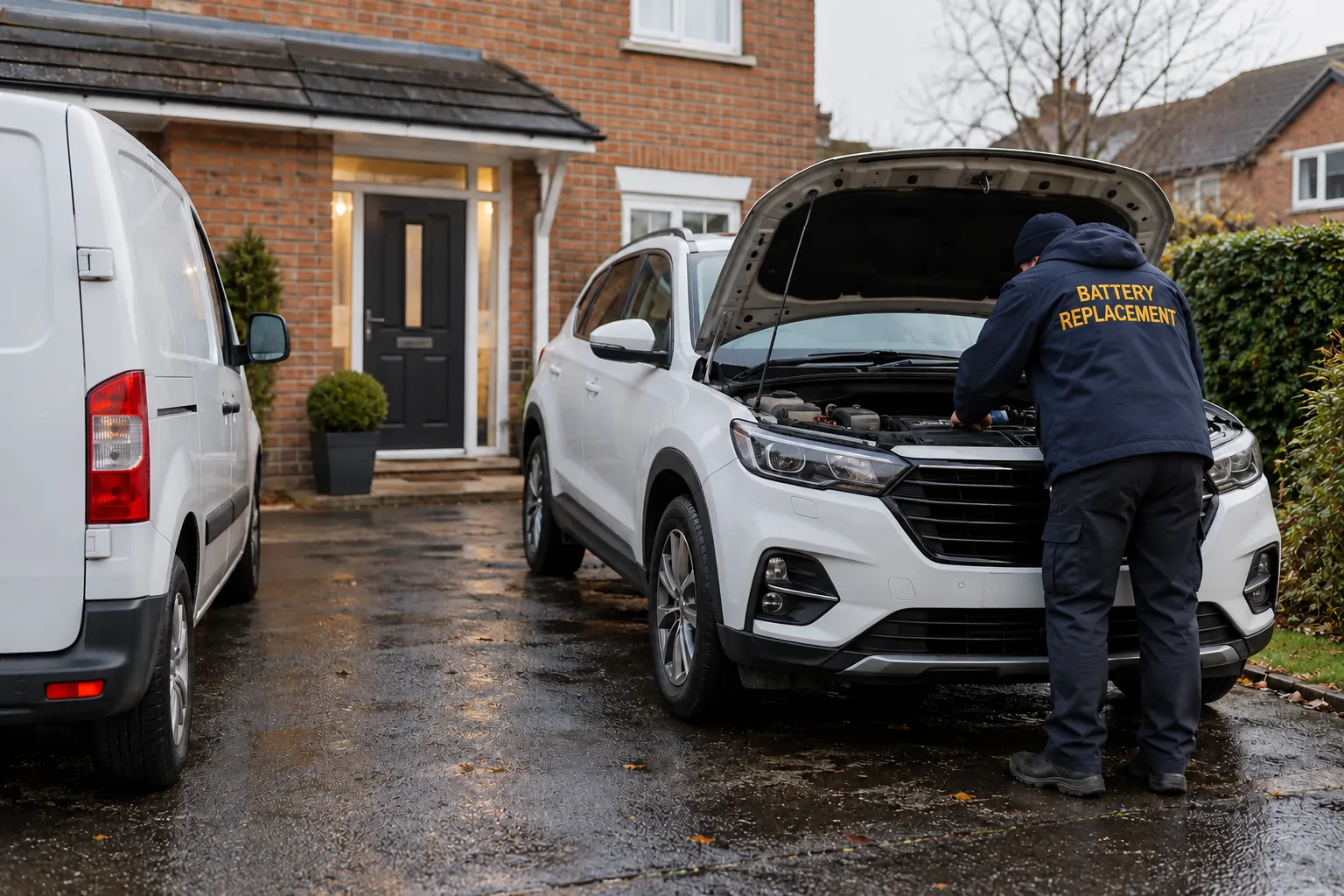
When a car will not start at home or at work, having a new battery fitted where it sits saves a tow and a morning lost at a garage. Mobile battery fitting goes smoothly when we know a few things before the call ends. This is what helps, and what to expect once we get to the car.
If you are stuck on a motorway
Battery work does not happen on the hard shoulder of the M50, the M1 or any other motorway. Turn on the hazard lights, get out on the side away from traffic if it is safe to do so, and wait behind the barrier. If anyone is hurt or the car is stopped in a live lane, ring 112 first. A mobile battery fitting is for a car parked at a house, a workplace, a car park or a quiet side street.
What to tell us when you ring
- Where the car is. The address or Eircode, and whether it is on a driveway, on the street, or in a multi-storey or basement car park. Mention any height barrier, gate or access code.
- The car. Make, model and year, plus the registration if you have it to hand.
- What it does. Nothing at all, a single click, a slow turning engine, or a dashboard full of warning lights.
- Start-stop. If the engine cuts out at traffic lights and restarts by itself, the car most likely needs an EFB or AGM battery.
- Electric or hybrid. These cars carry a separate small 12V battery as well as the main pack, and that is the one we deal with.
Why the registration helps
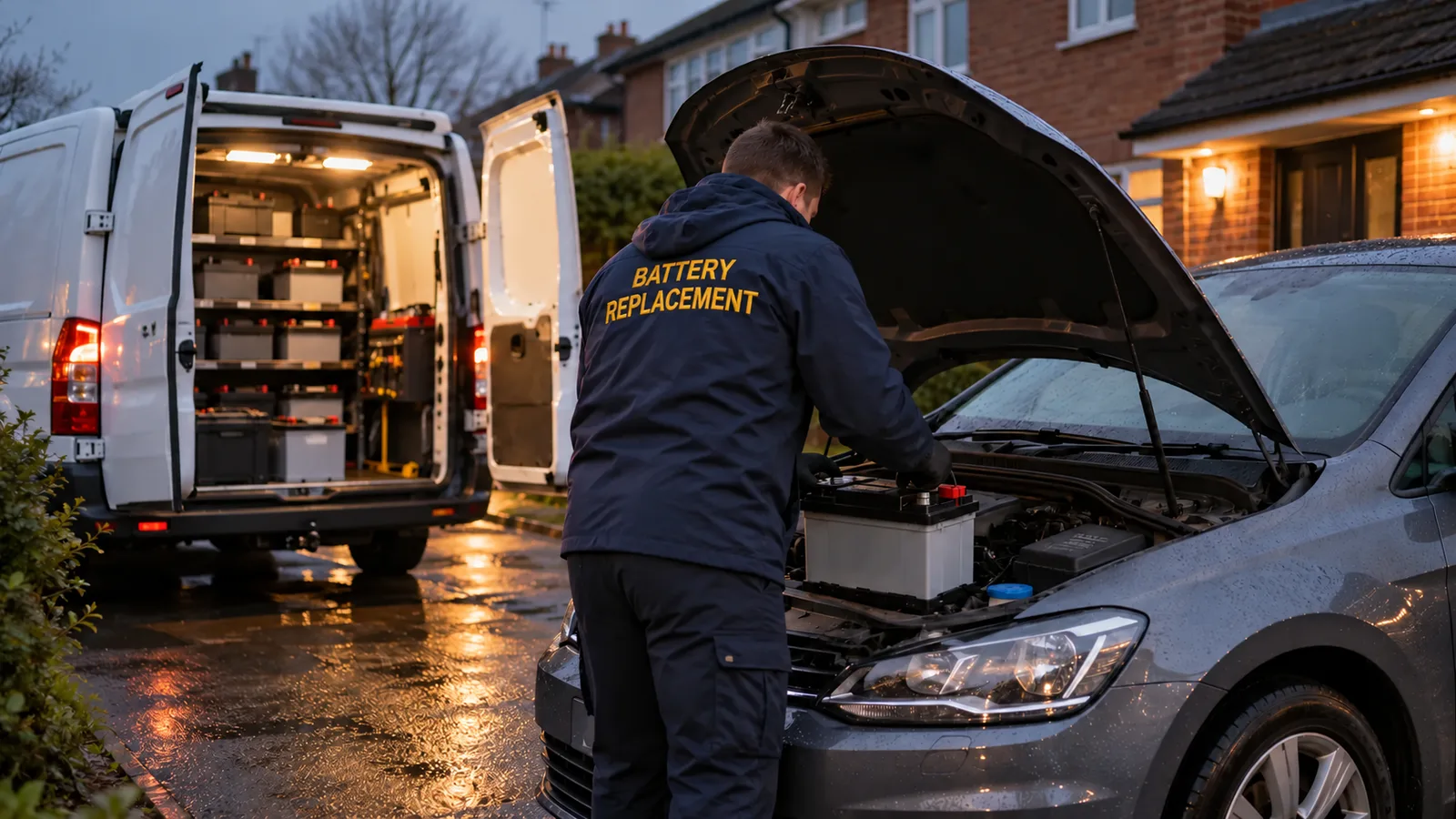
Car batteries come in many case sizes. The position of the positive terminal, the ledge the clamp holds at the base and the power rating all have to suit the car. With the registration and model year we can check the specification before anyone sets off, so the battery we bring is the one your car was built to take. Our guide to choosing a new car battery explains the labels in more detail.
Getting the car ready
- Find the keys and know where the bonnet release is.
- On some cars the battery lives in the boot, under the floor panel or beneath a seat. Clear the boot if you can.
- If the handbook lists a radio security code, keep it handy. A few older cars ask for it after the battery has been disconnected.
- If the car is tight against a wall or another car, say so on the phone, as the bonnet needs room to open.
At the car
The old battery and the charging are checked first, because a car that will not start is not always down to the battery. A tired starter motor or a failing alternator can look much the same, as we explain in car won’t start: battery, starter motor or alternator. If the battery is the cause, it comes out, the clamps and terminals are cleaned and checked, and the new one is fitted and secured.
Many newer cars, particularly those with start-stop, expect a new battery to be registered with the car’s computer so it charges correctly. Whether yours needs this depends on the make and model, so ask when you ring.
Afterwards
You may need to set the clock again, and on some cars the electric windows have to be run fully up and down once so they relearn their stops. The old battery contains lead and acid and should go for recycling. Ask on the phone whether taking it away is included in your price.
What it costs
Batteries are supplied and fitted for a €150 call-out, plus the battery. The final figure depends on the battery your car takes, so we confirm the full fitted price on the phone before the visit. The battery price guide shows the ranges.
To book a mobile battery fitting in Dublin or Meath, ring 085 783 9202 with the registration and where the car is parked.